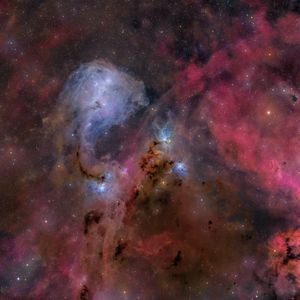
The Nebulas of Monoceros – Four-Panel Mosaic
April 1, 2023
Use mouse wheel to zoom, drag to pan, and buttons for other options
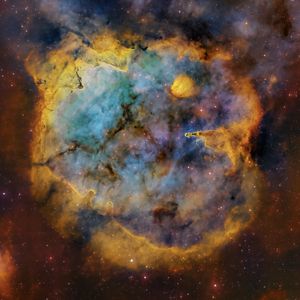
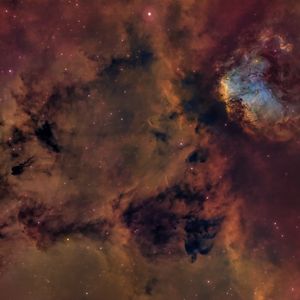
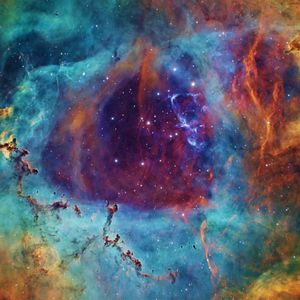
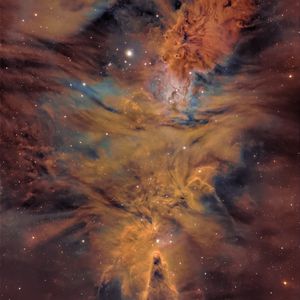
This four-panel mosaic cuts a significant swath through the Monoceros constellation and exposes a significant number of its more well-known formations. These include the Christmas Tree Cluster, the Cone Nebula, Dreyer’s Nebula, and the Rosette Nebula as well as some more obscure nebulas.
While this is a wide field shot with one of my small telescopes, I’ve also produced a number much closer shots of some of these objects with larger telescopes. Links to those images are available at the bottom of this page under the Related Images heading.
In the meantime, lets take a look at the highlights moving, more or less, from left to right through the mosaic.
The Little Tulip (LBN 902) and the Razorback (LDN 1609 & 1610)
I gave these objects these names due to my overactive sense of pareidolia. You may see other shapes in them. I’ve not been able to find any scholarly research on either other than the fact that they made Beverly Lynds’ Catalogue of Bright Nebulae (LBN) and Catalogue of Dark Nebulae (LDN). Given their proximity to the Cone Nebula, a reasonable guess for their distance might be 2,700 light years. Much more information is available with the closeup image of this chunk.

Cone Nebula and Christmas Tree Cluster (NGC 2264) with the Fox Fur Nebula (Sh2-273)
Catalogued as part of NGC 2264, the Cone Nebula is about 2,700 light years away. The Cone is about ten light years tall. The origins of the cone shape remain unknown. Just to the left of the Cone in the frame is the Christmas Tree cluster, also part of NGC 2264, gets its name from its vaguely Christmas-tree-like structure, laying on its side in the image. The Fox Fur Nebula appears to the left and above the Christmas Tree. More information is available with the closeup shot of this area.

Dreyer’s Nebula (IC 447 and 2169)
This reflection nebula is catalogued as IC 447 and IC 2169. It’s a small part of what is called the Monoceros R1 Complex—a loose association of reflection regions, gas, dust, and young stars. It lies about 2,500 light years away.
The origin of the common name, Dreyer’s Nebula, is unknown. Edward Barnard actually discovered it in 1894, and it was added to Dreyer’s Index Catalogue as IC 447 in 1895. Although I got enough true-color data to bring this out, take a look at the closeup shot that brings out far more detail as well as the other small reflection nebulas in the area.

Hubble’s Variable Nebula – NGC 2261
Named after Edwin Hubble, NGC 2261 is a tiny (from our vantage) reflection nebula illuminated by the star R Monoceros (R Mon) approximately 2,500 light years from Earth. There is a tremendous amount of gas and dust in the area, and as it moves between us and NGC 2261, it causes the nebula to change in brightness from our point of view. Unfortunately, I have yet to go after a closeup of this one.

The Satellite Cluster and the Rosette Nebula – NGC 2244 & 2237
The Rosette Nebula is one of the most captivating objects in the night sky. It’s frequently cited, incorrectly, as NGC 2244. That designation, as well as Caldwell 50, refers to the open star cluster, called the Satellite Cluster, at its center. NGC 2237 refers to the nebula itself, as do Sh2-275 and Caldwell 49. An open star cluster is a group of stars likely born in the same stellar nursery, but not bound gravitationally and destined to find their own paths through the galaxy.
The pair are about 4,500 light years from Earth and the Rosette Nebula is huge—50 light years across. The Rosette Nebula glows with light emitted from ionized sulfur (red), hydrogen (green), and oxygen (blue). These gasses mix to form the expansive palette of colors you see in the image. There are a couple of more detailed shot of this on this website. One taken with the larger refractor, and the other taken with the large reflector.

LBN 947
Near the bottom-center of the frame lies a very nice emission nebula known only as LBN 947. Sadly, I cannot find a distance estimate for it, nor can I find any scholarly research on it.

Sh2-280
Sh2-280 is an emission nebula that appears to be part of the Rosette molecular cloud about 5,000 light years away.

Sh2-282
A companion (at least from our perch here on Earth) of Sh2-280, Sh2-282 is an emission nebula that is roughly at the same distance—5,000 light years give or take.

Sh2-283
Although tiny in the image, Sh2-283 is part of a large star forming region called the Monoceros Arc about 25,000 light years away that includes Sh2-284 (see below), Sh2-285 (not pictured), and Sh2-286 (also not pictured).

The Portal Nebula – Sh2-284
Sh2-284, the Portal Nebula, forms new stars within its expansive reach (by my possibly faulty math, that distance would mean it’s around 200 light years in diameter).
The Portal has been shaped by a young, hot cluster of stars in its midst that produce high-energy radiation that sculpts the surrounding gasses. That energy also excites and ionizes the atoms in those gasses so they give off their own light. There is more information and a closeup view here on the website.


Telescope

William Optics ZenithStar 61
Finding Chart

Click to expand
Image Capture
Location:
Back yard in North Dallas
Camera:
Total integration: 129h 6m 30s
Integration per filter:
- R: 1h 9m (138 × 30")
- R: 10h 45m (645 × 60")
- G: 1h 9m (138 × 30")
- G: 10h 45m (645 × 60")
- B: 1h 9m 30s (139 × 30")
- B: 10h 45m (645 × 60")
- Hα: 32h 30m (650 × 180")
- S2: 32h 15m (645 × 180")
- O3: 28h 39m (573 × 180")
Coordinates: 6h 37m 37s · +6° 1′ 8″
ZWO ASI6200MM-Pro

Awards